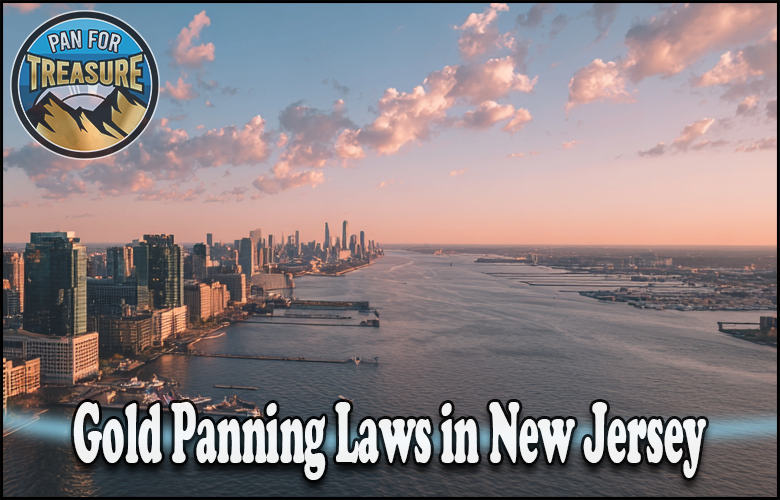
The gold panning laws in New Jersey are shaped by the fact that there is no federal public land (no BLM, no National Forest) and no state statute specifically addressing recreational gold panning. State parks prohibit removing any plant, animal, artifact, or physical feature under N.J.A.C. 7:2-2.10, which effectively bars gold panning in most state-managed areas. On private land, gold panning is legal with the landowner’s written permission. Some municipal and county parks may allow hand panning, but rules vary by jurisdiction and you must check with local authorities first.
New Jersey is not a gold-producing state. No commercial gold mining has ever operated here, and no gold rush has ever occurred. The gold that does exist is glacial placer, deposited by Pleistocene glaciers that carried mineral-bearing gravels south from Canada’s Abitibi Gold Belt. This gold is extremely fine (flour to microscopic), found in limited quantities in northern New Jersey streams. A few historical reports of lode gold in the state are generally considered unreliable, possibly the result of mine-salting scams.
Despite the challenges, recreational prospectors can find small amounts of gold in the right drainages with the right techniques. This guide covers the regulations, best locations, and tips for panning in the Garden State. For basics, see our getting started with gold panning guide.
TL;DR
- No state panning permit: New Jersey has no dedicated recreational gold panning permit or statute. Panning is governed by general property, trespass, and environmental laws.
- State parks: N.J.A.C. 7:2-2.10 prohibits removing any plant, animal, artifact, or physical feature from State Park Service property. Metal detectors require a permit from the park Superintendent (7:2-2.16). Gold panning is effectively not allowed in state parks.
- Private land: Legal with written landowner permission. Most gold-bearing streams cross private property.
- No federal land: New Jersey has no BLM or National Forest land, so there is no casual-use prospecting option on federal land.
- Gold type: Glacial flour gold only. Extremely fine, often microscopic. No nuggets. No commercial deposits.
- Best areas: Northern New Jersey streams in the glaciated region (Sussex, Warren, Passaic, Morris, Bergen counties).
Glacial Placer (Abitibi Gold Belt)
No Documented Commercial Production
Ultra-Fine Flour Gold, Microscopic
No State Permit (Landowner Permission Required)
Removal of Natural Features Prohibited
None (No BLM or National Forest)
Gold Panning Laws in New Jersey
New Jersey has no state statute or permit system specifically for recreational gold panning. The activity is regulated indirectly through property law, trespass law, state park rules, and environmental regulations administered by the New Jersey Department of Environmental Protection (DEP). Since there is no federal public land in the state, there are no BLM casual-use provisions or National Forest rules to fall back on.
State Parks and State Forests
Under the New Jersey State Park Service Code (N.J.A.C. 7:2), a person shall not damage or remove any plant, animal, equipment, furniture, structure, artifact, or physical feature of any kind from State Park Service property (7:2-2.10). This broad prohibition covers rocks, soil, gravel, and minerals. Gold panning involves removing streambed material, which falls under this rule.
Metal detector use on state park property requires a permit from the park Superintendent or designee (N.J.A.C. 7:2-2.16). Even with a metal detector permit, removing subsurface objects that are artifacts or physical features of the park would still be restricted. Natural areas within the state park system have additional protections under N.J.A.C. 7:5A.
County and Municipal Parks
Rules for county and municipal parks vary by jurisdiction. Many county and municipal park ordinances include provisions similar to the state rule, prohibiting removal of soil, rock, sand, stones, or other materials. For example, some municipal codes prohibit making “any excavation by tool, equipment, blasting or other means” in public parks. Contact the specific county parks department or municipal recreation office before attempting to pan in any public park or recreation area.
Private Land
Gold panning on private land is legal with the landowner’s written permission. Since nearly all gold-bearing streams in New Jersey flow through private property, this is the primary legal option for recreational prospectors. The landowner owns the minerals in and under their property. Get permission before you start, and respect the landowner’s conditions regarding equipment, hours, and site restoration.
Waterways and Wetlands
New Jersey’s Land Use Management Program regulates activities in waterways, wetlands, and flood hazard areas. Mechanized dredging or significant disturbance of streambeds could trigger permitting requirements under the Freshwater Wetlands Protection Act (N.J.S.A. 13:9B) and the Flood Hazard Area Control Act (N.J.S.A. 58:16A). Simple hand panning with a gold pan on private land with landowner permission is unlikely to trigger these regulations, but using a motorized suction dredge or highbanker almost certainly would.
Equipment Restrictions
| Equipment | Private Land (With Permission) | State Parks / State Forests | County / Municipal Parks |
|---|---|---|---|
| Gold Pan | Allowed with landowner permission | Not allowed (removal prohibited) | Varies, check local rules |
| Hand Trowel / Shovel | With landowner permission | Not allowed | Usually prohibited |
| Classifier / Screen | With landowner permission | Not allowed | Varies, check local rules |
| Sluice Box | With landowner permission | Not allowed | Usually prohibited |
| Suction Dredge / Motorized | May require DEP permits | Not allowed | Not allowed |
| Metal Detector | With landowner permission | Permit required from Superintendent | Varies by jurisdiction |
For gear recommendations suited to fine gold recovery, see our best tools for gold panning roundup.
Best Locations for Gold Panning in New Jersey
Gold in New Jersey is concentrated in the northern part of the state, within the area covered by Pleistocene glaciers. The terminal moraine (the southern limit of glacial advance) runs roughly through the middle of the state, from Perth Amboy westward through Morristown and into Warren County. North of this line, glacial deposits may contain trace amounts of gold carried south from Canadian source rocks. South of this line, gold is extremely unlikely. For more detail, see our page on whether there’s gold in New Jersey. Always get written landowner permission before panning.
- Pequest River (Warren and Sussex Counties) – The most commonly cited gold panning location in New Jersey. The Pequest flows through glacial deposits in northwestern New Jersey. Reports of trace gold and even trace platinum have been made by recreational prospectors. The river has public access points, but check whether panning is allowed at each. Much of the riverbank is private property.
- Musconetcong River (Warren, Hunterdon, and Morris Counties) – Another glacial-wash river in northern New Jersey. It has high concentrations of heavy minerals, including copper and zinc, which are often geologically associated with gold. Look for areas where the river slows after bends. Mostly private land.
- Delaware River (Warren, Hunterdon, and Mercer Counties) – The Delaware acts as a major drainage for the region. Extremely fine flour gold has been reported, though recovery requires patience and fine-gold techniques. Public access exists at boat launches and fishing access sites, but panning rules at state or federal recreation areas along the river must be confirmed.
- Ramapo River (Passaic and Bergen Counties) – Flows through northern New Jersey’s Highlands region. Traces of gold have been reported. The Ramapo Mountains have a long mining history (primarily iron). Public access is available at some points, but much of the river corridor is private.
- Paulinskill River (Sussex and Warren Counties) – A tributary of the Delaware in northwestern New Jersey. Occasional gold finds have been reported. The river flows through glaciated terrain. Access is limited; check property ownership.
- Rockaway River (Morris County) – Flows through the New Jersey Highlands, an area with a long history of iron and zinc mining. Where base metals were mined, trace gold sometimes appears as a secondary mineral. Mostly private land.
- Wanaque River (Passaic County) – Drains the Ramapo Mountains. Glacial deposits in the drainage may contain trace gold. Access is limited due to the Wanaque Reservoir watershed restrictions.
- Pequannock River (Morris and Passaic Counties) – Another Highlands river with glacial deposits. Some of the watershed is protected for water supply, limiting access.
- Peach Bottom Creek (Salem County) – In southern New Jersey, this creek has historical reports of gold. It lies south of the glacial limit, so any gold here would be from a different geological source. Reports are unconfirmed but worth investigating with landowner permission.
- Old Mine Sites in the Highlands (Sussex, Morris, and Passaic Counties) – New Jersey’s Highlands region has hundreds of abandoned iron and zinc mines. Tailings piles near old mines occasionally contain trace precious metals that 19th-century miners were not looking for. Do not enter abandoned mine shafts. Surface collecting on private land requires landowner permission.
Gold Prospecting History in New Jersey
New Jersey has no gold rush history and no documented commercial gold mining. The state’s mining heritage is built on iron (which fueled the Revolutionary War and the Industrial Revolution) and zinc (the famous Franklin and Sterling Hill mines in Sussex County). The New Jersey Highlands were one of the most productive iron mining regions in colonial America.
Reports of gold in New Jersey date to at least 1722, when a “mixed mine of silver and gold” was claimed somewhere in the state. Gold occurrences have been reported in association with copper ore in the Piedmont Province, with small finds noted at mines in Bergen County, Somerset County, Sussex County, Warren County, and Morris County. However, most of these reports are either unconfirmed or involved trace quantities recovered as byproducts of base metal mining.
A few historical claims of rich gold veins in New Jersey are generally considered to have been mine-salting scams, a common practice in the 1800s. Promoters would seed worthless prospects with gold to attract investor money. Geologists have found no evidence of significant lode gold deposits anywhere in the state.
The gold that does exist in New Jersey arrived via glaciers during the Pleistocene epoch. Ice sheets advancing south from Canada carried material from gold-bearing source rocks, including the Abitibi Gold Belt in Ontario and Quebec. When the glaciers melted (roughly 12,000-15,000 years ago), they left behind till and outwash deposits containing trace amounts of gold. This glacial gold is widely distributed across northern New Jersey but is extremely fine-textured and present in very low concentrations.
Tips for Gold Panning in New Jersey
- Set realistic expectations. New Jersey is one of the least productive states for gold. You will not find nuggets or visible flakes. Expect microscopic flour gold that requires a magnifying glass and a snuffer bottle to see and collect. This is a state where the experience and the learning are the reward, not the gold itself.
- Get landowner permission for every location. Since there is no federal public land and state parks prohibit removing natural features, private land with landowner permission is your primary legal option. Check county tax maps, knock on doors, and get written permission. Some landowners are happy to let prospectors try their luck. See our permits guide for tips on securing access.
- Stay out of state parks with a gold pan. N.J.A.C. 7:2-2.10 prohibits removing any physical feature from state park property. Do not pan in state parks, state forests, or state recreation areas unless you have confirmed with the park Superintendent that it is allowed.
- Focus on northern New Jersey. All glacial gold in the state is north of the terminal moraine, which runs roughly from Perth Amboy through Morristown to the Delaware Water Gap. Sussex, Warren, Passaic, Morris, and Bergen counties are the most likely to produce gold. Streams south of this line are very unlikely to contain gold. For panning techniques, see our beginner techniques guide.
- Use fine gold recovery equipment. Standard panning techniques will miss New Jersey’s ultra-fine gold. Use a spiral pan (like the Garrett Gravity Trap), pan very slowly, and use a snuffer bottle for recovery. A gold panning kit designed for fine gold is recommended. Look for gold underneath black sand concentrates.
- Sample many locations. Since there were never commercial placer deposits in New Jersey, there is limited documentation of where gold concentrates. You need to sample multiple streams and sections. Pan a few pans at each spot and move on if you find nothing. The next stream over the ridge may be different.
- Look at old mine tailings (with permission). New Jersey’s Highlands have hundreds of abandoned iron and zinc mines. Tailings piles near old mines may contain trace gold that 19th-century miners ignored. Never enter abandoned mine shafts. Surface picking and panning of tailings material is only allowed with the landowner’s permission.
- Check local ordinances for county and municipal parks. Some county or municipal parks may not have the same strict removal prohibitions as state parks. Contact the parks department directly and ask about gold panning. Some may allow hand panning as a recreational activity.
- Consider a day trip to Pennsylvania or New York. If you want a more productive gold panning experience, southeastern Pennsylvania (York and Lancaster counties) and parts of New York state have documented glacial and lode gold. The drive from northern New Jersey is short, and the gold deposits are richer. See our best places to pan in America guide.
- Join a prospecting club. The GPAA and regional prospecting forums connect New Jersey hobbyists with others who have local knowledge. Group outings can provide access to private land that individual prospectors cannot reach.
Resources for New Jersey Prospectors
- N.J.A.C. 7:2 – State Park Service Code – Full text of New Jersey state park rules, including prohibitions on removing natural features and metal detector permit requirements.
- New Jersey Department of Environmental Protection (DEP) – State agency overseeing parks, land use, wetlands, and environmental regulations.
- New Jersey Geological and Water Survey – State geological survey with information on mineral resources, bedrock geology, and glacial history.
- NJ Division of Parks and Forestry – Manages state parks, forests, and recreation areas. Contact individual park offices for activity-specific rules.
- Gold Prospectors Association of America (GPAA) – National organization with regional chapters and online forums for New Jersey prospectors.
Conclusion
The gold panning laws in New Jersey do not prohibit recreational hand panning on private land with the landowner’s permission, but the state offers very few public-access options. State parks prohibit removing natural features under N.J.A.C. 7:2-2.10, and there is no BLM or National Forest land in the state. Your best legal option is private land access, secured through written permission from the property owner.
New Jersey’s gold is glacial, extremely fine, and present in very low concentrations. No commercial gold mining has ever operated in the state. Northern New Jersey streams in Sussex, Warren, Passaic, Morris, and Bergen counties offer the most likely prospects, but expectations should be modest. The Pequest River and Musconetcong River are the most commonly cited locations. For prospectors willing to do the research and secure private land access, finding a few specks of gold in the Garden State is a genuine possibility. For more on the state’s gold, see our is there gold in New Jersey page.
Check out the laws in New Hampshire, Delaware, Maryland, Connecticut, and Massachusetts, or browse our full gold panning laws by state directory.
Frequently Asked Questions – NJ Gold Panning Laws
Is gold panning legal in New Jersey?
Yes, on private land with the landowner’s written permission. There is no state law that specifically prohibits recreational hand panning on private property. However, state parks prohibit removing any physical feature from park property under N.J.A.C. 7:2-2.10, which effectively bars gold panning in state-managed areas. County and municipal park rules vary; check with local authorities.
Do I need a permit to pan for gold in New Jersey?
There is no state-issued recreational gold panning permit. On private land, you need the landowner’s written permission. On state park property, panning is generally not allowed. Metal detectors on state park property require a permit from the park Superintendent. Motorized dredging in waterways may trigger DEP wetlands and land use permits.
Can I pan for gold in New Jersey state parks?
Practically speaking, no. N.J.A.C. 7:2-2.10 states that a person shall not damage or remove any plant, animal, artifact, or physical feature from State Park Service property. Gold panning involves removing streambed material, which falls under this prohibition. Contact the individual park Superintendent if you want to confirm.
Is there really gold in New Jersey?
Yes, in very small quantities. Glacial gold was deposited across northern New Jersey by Pleistocene ice sheets that carried material south from Canada’s Abitibi Gold Belt. This gold is extremely fine (flour to microscopic) and widely dispersed. No commercial gold deposits have ever been found in the state, and no gold rush has ever occurred.
Where is the best place to find gold in New Jersey?
The Pequest River in Warren and Sussex counties is the most commonly cited location. The Musconetcong River, Ramapo River, and Paulinskill River in northern New Jersey are also mentioned by recreational prospectors. All gold-bearing areas are in the glaciated northern portion of the state, north of the terminal moraine.
Should I just go to Pennsylvania or New York instead?
If finding gold is your primary goal, neighboring states offer richer deposits. Southeastern Pennsylvania (York and Lancaster counties) has documented glacial and lode gold. Parts of New York state also have productive placer streams. However, the experience of finding gold in New Jersey, where few people even try, has its own appeal.

⛏ Recommended Gear ⛏


* As an Amazon Associate I earn from qualifying purchases at no extra cost to you.
Subscribe to Our Newsletter

Ryan Conlon is the founder of Pan for Treasure.
A lifelong gold panning enthusiast, he created this site to help beginners learn the ropes and share practical tips from his own time on the creek. [email protected]